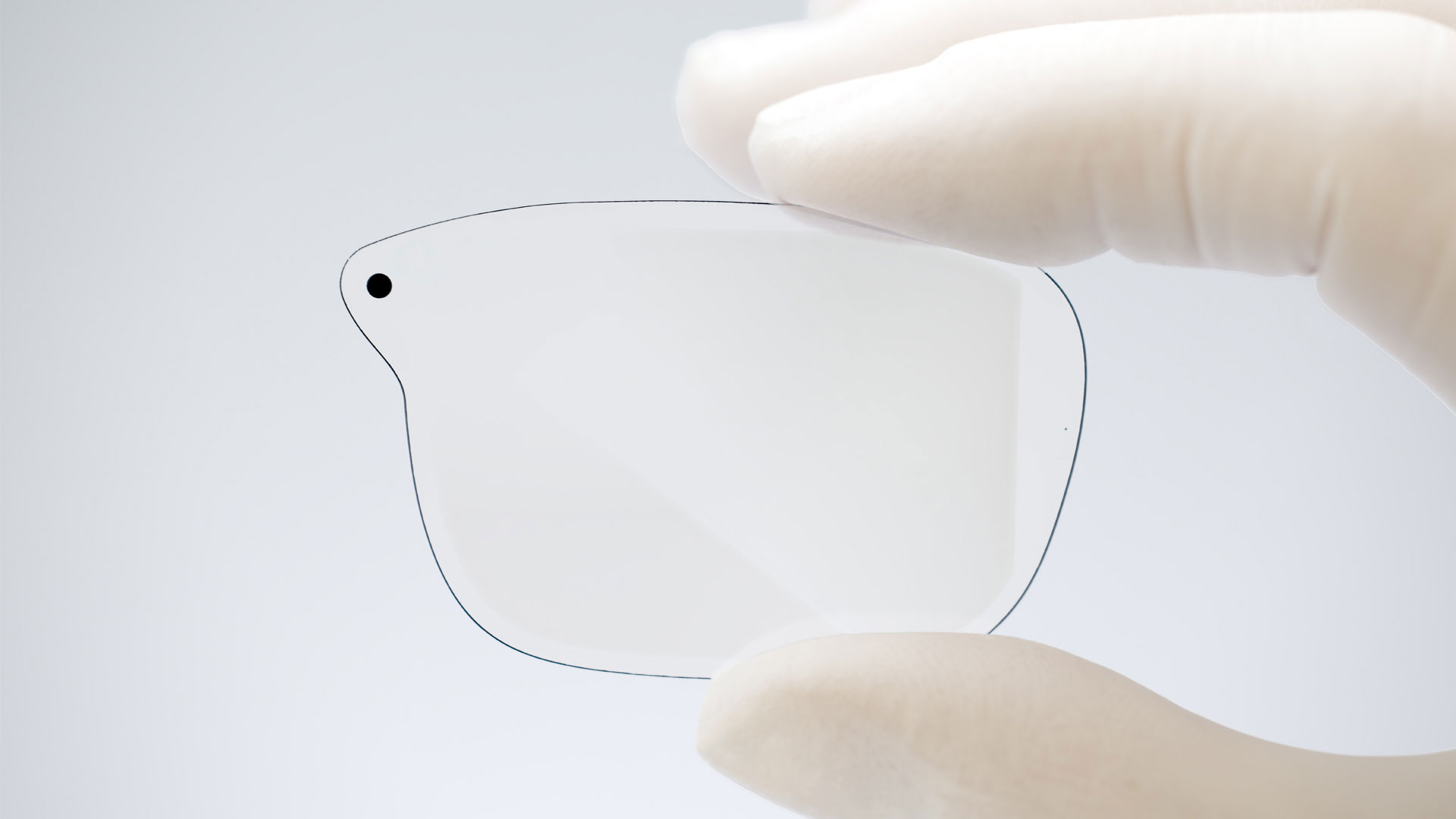
At first glance, an augmented reality (AR) waveguide looks surprisingly simple. It appears to be little more than a thin, transparent piece of glass that seamlessly overlays digital content onto the physical world. What you don't see is the remarkably complex journey light takes before a virtual image ever reaches your eye.
That journey is made possible through diffraction. While diffraction may sound highly technical, it is simply a process used to direct light exactly where it needs to go. By carefully controlling how light moves through an optical waveguide, engineers can create bright, clear virtual images while preserving a clear view of the physical world. Understanding that journey helps explain why diffraction is one of the foundational technologies behind modern AR displays.
Why Diffraction Matters
Unlike a traditional display that projects light straight to the viewer, a waveguide first directs light into a thin piece of transparent glass or polymer before guiding it across the display to the correct viewing position. Every step of that journey depends on diffraction.
Diffraction occurs when light encounters sub-micron structures that are precisely engineered to redirect it in specific directions. Measured in nanometers, these features determine how light enters the waveguide, how it travels across it, and where it ultimately exits to form a virtual image.
These tiny diffractive structures give optical engineers another way to control light with extraordinary precision, complementing optical principles like reflection and refraction. From brightness and color uniformity to field-of-view, nearly every aspect of optical performance begins with directing light exactly where it needs to go.
Following Light Through a Waveguide
Once light enters a waveguide, its journey is just beginning. Instead of traveling immediately to the viewer, it repeatedly reflects within the waveguide through a phenomenon known as total internal reflection.
Along the way, it encounters carefully engineered diffraction gratings that redirect only a controlled portion toward the viewer while allowing the remaining light to continue through the waveguide.
Imagine if all of the light exited the waveguide the first time it encountered a grating. One area would appear incredibly bright while the rest of the display would quickly fade. Engineers avoid this by intentionally extracting only a small portion of the light during each grating interaction, gradually distributing it across a much larger viewing area.
This process, known as pupil expansion, expands the viewing area and allows users to move their eyes naturally while continuing to see a stable virtual image. Behind the scenes, engineers carefully tune how much light leaves the waveguide during each interaction. This ensures brightness remains consistent across the entire eyebox, the three-dimensional space where your eye must be to see the full, clear image projected by the waveguide.
To the user, this entire process is invisible. They simply see a bright, stable virtual image that remains consistent as their eyes move within the viewing area. Behind that seemingly effortless experience are countless precisely engineered interactions, each directing another small portion of light exactly where it belongs.
Shaping Performance with Pitch
If diffraction determines where light travels, grating pitch helps determine how it gets there.
Grating pitch refers to the spacing between neighboring grating features, much like the distance between grooves on a vinyl record. Changing that spacing by only a few nanometers significantly alters how light behaves inside the waveguide. Even those subtle adjustments influence the angle at which light is redirected, affecting everything from field-of-view to color performance.
Designing the right grating pitch involves much more than choosing how far apart those features should be. Engineers must consider the wavelength, or color, of the projected light, along with how quickly light travels through the waveguide material. Because light behaves differently in different materials, the ideal spacing between gratings will also vary. These factors all work together to determine how light moves through the waveguide and ultimately reaches the viewer.
A single waveguide may use multiple grating pitches in different regions and angles of orientation to guide light efficiently from beginning to end. A display designed for lightweight information overlays, for example, may require a different optical solution than one intended for immersive spatial experiences with a wider field-of-view.
Engineers optimize diffraction efficiency by directing available light where it provides the greatest benefit. The result is consistent brightness and image quality while supporting the intended viewing experience.
Managing Diffraction Artifacts
Successful waveguide design depends on shaping how light diffracts throughout the optical system. This process preserves the interactions that create the virtual image while minimizing those that introduce unwanted optical artifacts.
The same diffraction that makes transparent displays possible can also introduce visual artifacts if it is not carefully managed.
Unwanted rainbows, ghost images, haze, and color non-uniformity all originate from the complex ways light interacts with optical structures. Bright ambient light can produce visible rainbow-like diffraction effects. Separately, small amounts of projected light can sometimes follow unintended paths through the waveguide, creating faint secondary images or subtle color variations.
Reducing these artifacts requires engineers to account for several aspects of the display system, including the light engine specifications, the waveguide design and manufacturing process. Optical modeling and precision manufacturing help control how light travels through the waveguide. Specialized coatings and planarization techniques can further reduce unwanted interactions with ambient light while preserving the desired diffraction behavior. Planarization fills in the nanoscale grooves between grating features with a transparent material, creating a smoother optical surface while allowing the diffraction structures beneath to continue directing light as designed.
Refining this behavior is an iterative process. Optical models predict how both projected light and ambient light will interact with the waveguide. Manufacturing processes reproduce those designs with nanoscale precision, and metrology verifies that the finished structures match the engineered geometry. Each stage informs the next, steadily improving both optical performance and manufacturability.
Designing Around Light
Because each AR product has its own goals and demands on their optical systems, diffraction must be engineered to support each application's priorities. Some designs emphasize expansive fields-of-view and immersive experiences. Others prioritize brightness, power efficiency, or lightweight eyewear.
Light engine characteristics, wavelengths, polarization, material selection, and optical architecture all contribute to the final design. No single waveguide configuration is ideal for every application, which is why successful development depends on understanding how these variables work together.
Although every waveguide must operate within the same laws of physics, no two products ask light to behave in exactly the same way. By combining optical modeling, waveguide design, advanced manufacturing, and prototyping expertise, we help partners shape that journey to meet their unique product goals.
Explore more stories about waveguide engineering and optical innovation to learn how we're helping partners transform complex optical challenges into practical AR solutions.