Imagine putting on a pair of augmented reality (AR) glasses and seeing a bright, perfectly positioned virtual image. Then the glasses shift slightly on your nose and part of the image disappears. You adjust them and it returns, only to become clipped again when you glance toward the edge of the display.
AR glasses shouldn't require a wearer to continually search for the perfect position just to see the virtual world clearly. One of the optical design considerations that makes that natural experience possible is the eyebox.
Why Do Eyeboxes Matter?
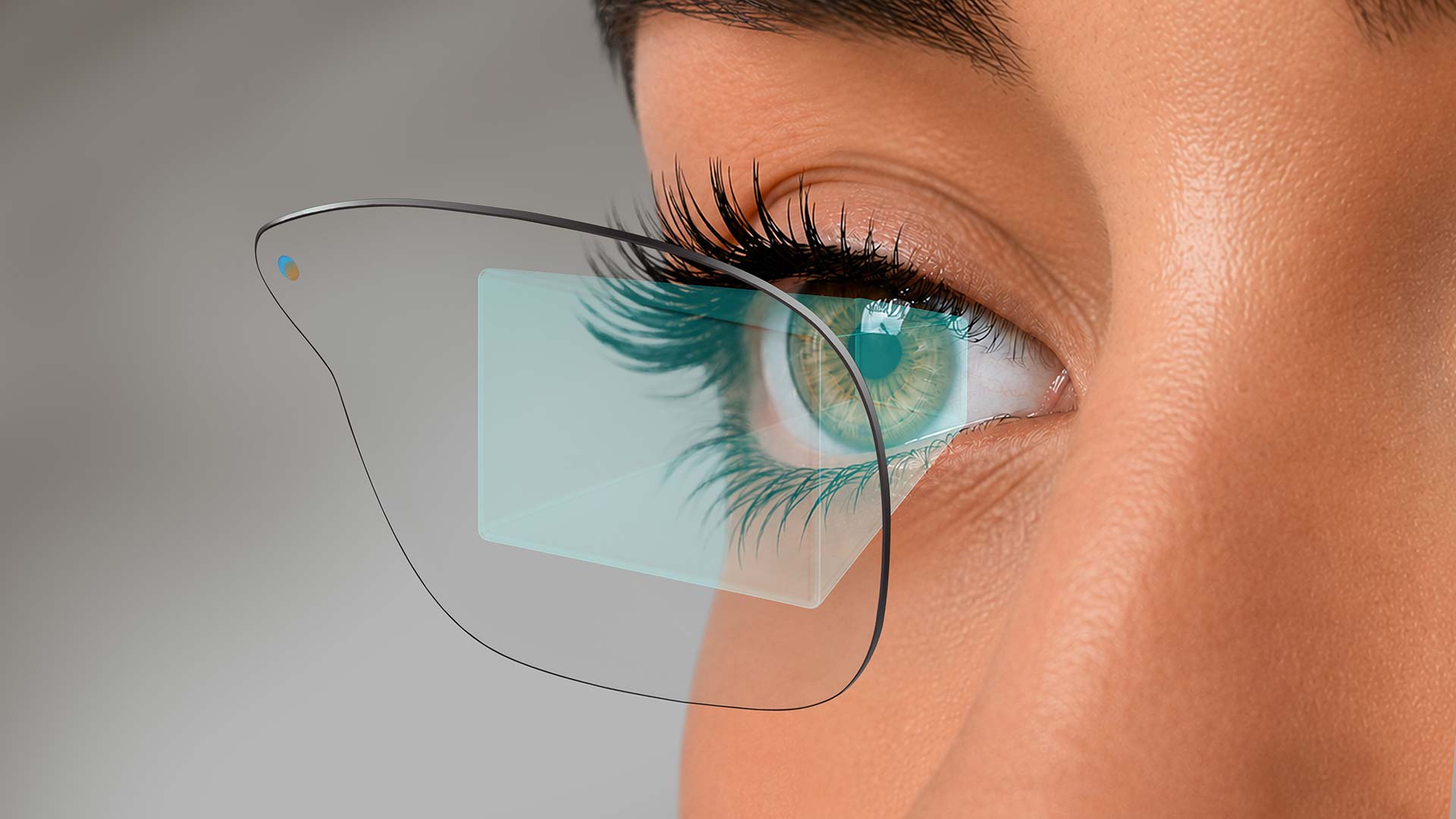
In AR glasses, the eyebox is the area where the eye must be positioned to see the virtual image clearly.
Inside the eyebox, digital content appears bright, sharp, stable, and properly aligned with the physical world. When the eye is positioned outside the eyebox, the digital image may become dim, cut off, distorted, blurry, or it may disappear altogether.
Larger eyeboxes provide more freedom for eye movement and variation in how the glasses sit on the face, while smaller eyeboxes require more precise eye positioning.
As a result, the eyebox influences nearly every aspect of the AR experience, from what people see to how the glasses fit and perform. Its design affects usability, comfort, calibration, and manufacturing.
Image Quality
The eyebox defines the viewing area where the virtual image appears. When a wearer’s eyes are properly aligned with the eyebox, this helps ensure digital content appears clear and stable.
Fit Tolerance
The dimensions of the eyebox impact how well AR glasses will fit different people. A larger, well-positioned eyebox provides more freedom in how the wearer can place the glasses on their face, helping the device to fit and behave more like traditional eyewear.
Visual Comfort
An effective eyebox helps maintain a stable image without requiring frequent adjustments as the glasses naturally shift during physical movement and extended wear.
Calibration Accuracy
During factory calibration, our teams identify and correct any display misalignments so digital content appears where it should. Although calibration does not change the eyebox itself, a smaller eyebox leaves less room for variation, requiring more adjustments and customization to achieve the intended viewing experience.
A Well-Designed Eyebox
better aligns to the fit and behavior we expect from traditional eyewear.
- Digital content remains visible during normal head and eye movements.
- The device is more comfortable to look through.
- A wider range of facial features and head shapes can wear the design.
A Poorly Designed Eyebox
fails to meet standard expectations for traditional eyewear fit and performance.
- Requires frequent repositioning of the glasses to regain a clear image.
- Portions of the image disappear or become distorted.
- Wearability is limited because fewer people can comfortably wear the device.
Where Waveguides Come In
The waveguide controls how light travels from the display to the user’s eye, directly linking waveguide design to eyebox performance. Decisions made during waveguide design influence the shape, size, and location of the eyebox. For this reason, engineers consider eyebox performance throughout the waveguide development process, balancing it alongside image quality, efficiency, field-of-view, and manufacturability.
How to Design an Effective Eyebox
Engineers must balance optical performance, industrial design, manufacturing requirements, and design for human variability to create a system that works reliably across many facial characteristics. These competing requirements create some of the most complex challenges in AR display development.
Challenge 1: Accounting for Human Variability
AR glasses must accommodate significant differences in facial and cranial anatomy. Human factors such as interpupillary distance (IPD), nose shape, and head size all influence where a person’s eyes sit relative to the optical system.
We are heavily invested in anthropometric data, with one of the most comprehensive biometric datasets for AR design. This information enables us to create human-first designs, including nosepieces, which ensure the glasses fit on the face properly and the eyebox is correctly positioned.
Engineers must design an eyebox that naturally aligns with these differences without requiring excessive adjustments or custom fittings.
Challenge 2: Balancing Optical Tradeoffs
Adjusting the eyebox impacts many other aspects of the optical system, including field-of-view, efficiency, image quality, waveguide architecture, and the overall device size. Every adjustment must be evaluated as part of the complete optical system.
This is one of the reasons why we insist on working so closely with our partners throughout the waveguide design process. By understanding our partners’ product goals and requirements, we are able to confirm design feasibility, offer insights or alternatives if needed, and ensure our waveguide designs fit and perform alongside other hardware components.
Beyond the Eyebox
Eyebox design illustrates one of the central challenges of AR glasses development: creating a waveguide that delivers a consistent viewing experience across a wide range of users and conditions. Meeting this challenge requires collaboration between optical engineering, calibration, human factors, and industrial design teams, whose expertise helps ensure the waveguide performs reliably and consistently.
Our integrated approach brings these disciplines together throughout the development process, enabling us to create waveguides that balance optical performance and manufacturability with everyday usability.
Learn more about how our human factors research and data inform our design decisions.