Surface relief gratings (SRGs) are among the smallest features found inside an augmented reality (AR) waveguide, yet they influence nearly every aspect of the viewing experience. These nanoscale structures control how light enters the waveguide, travels through the optical system, and ultimately reaches the user's eye. Changing their geometry changes how the waveguide behaves, allowing engineers to emphasize brightness, improve color uniformity, expand the field-of-view, or balance other aspects of optical performance.
Although every one of our waveguides relies on diffraction to guide light, there is no single grating design that works best for every application. A display intended for immersive visualization has different optical priorities than one designed for lightweight information overlays. Engineers select grating architectures based on the brightness, field-of-view, image quality, efficiency, and manufacturability required for the intended application.
Every Grating Solves a Problem
Surface relief gratings all perform the same basic function by redirecting light through diffraction, but they do so in different ways. Changing the shape, angle, or spacing of these tiny structures alters how efficiently light moves through the waveguide and how the final image appears to the user.
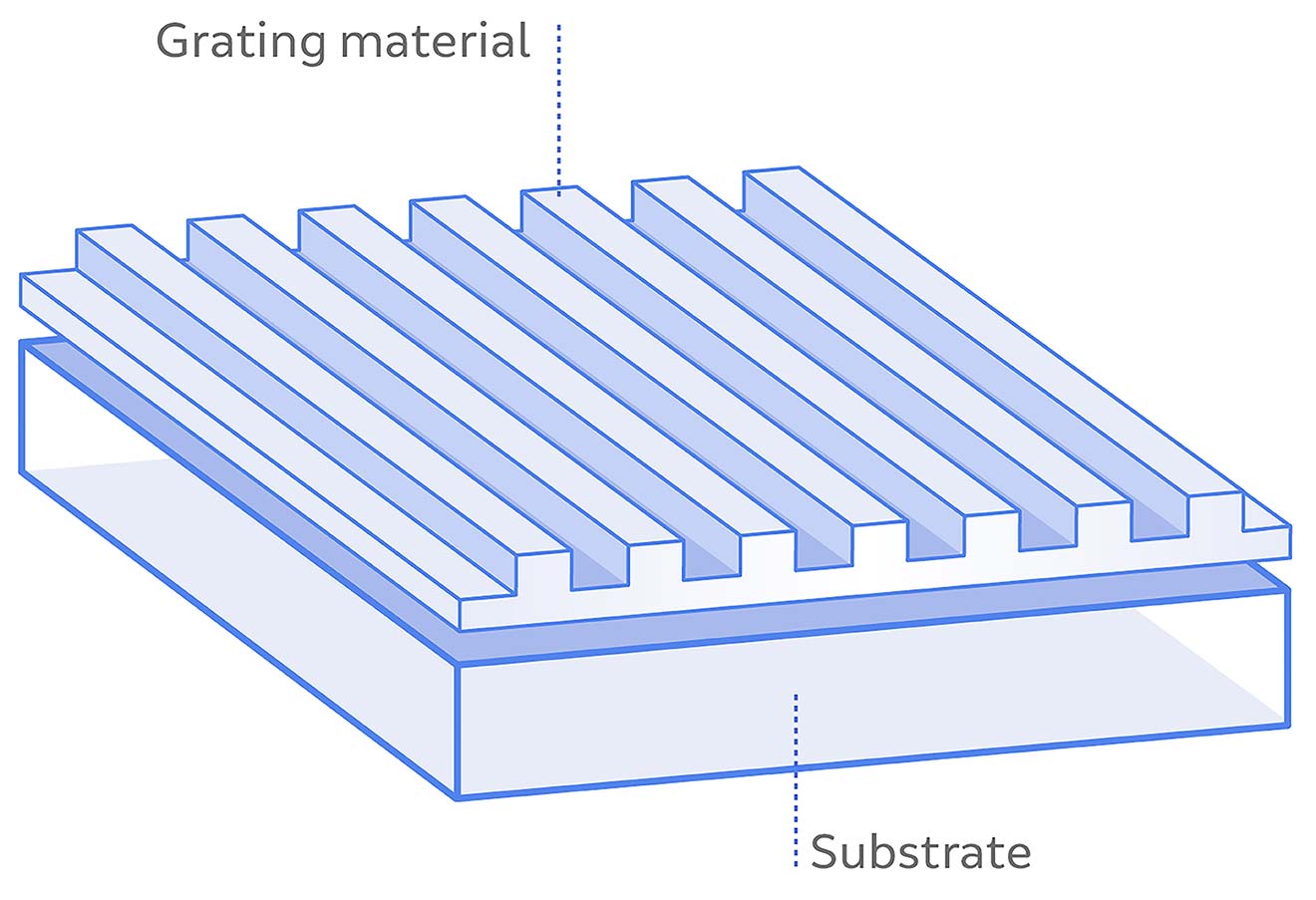
Binary, blazed, slanted, multi-level, and variable pitch gratings give designers different ways to balance optical performance and manufacturability. Some emphasize simplicity and repeatability during manufacturing, while others redirect light more efficiently or influence how it behaves as it travels across the waveguide.
That flexibility becomes increasingly important as AR products continue to diversify. A compact display intended for glanceable information may prioritize different characteristics than an immersive system designed for a wide field-of-view. The application ultimately determines which grating architecture offers the most appropriate balance of optical performance and manufacturability.
Balancing Brightness with Image Quality
Designing a waveguide is rarely about maximizing one performance metric. Increasing diffraction efficiency, for example, can make a display brighter, but experienced waveguide designers know that brightness alone doesn't produce a better display.
If too much light leaves the waveguide too quickly, brightness can become uneven across the image. Engineers must also consider color uniformity, image consistency, field-of-view, and unwanted artifacts such as ghost images. Every improvement introduces new tradeoffs, making waveguide design a continual exercise in balancing competing priorities.
One of the clearest examples is how light is extracted from the waveguide.
If the first gratings extracted every bit of available light, the image would begin bright and quickly fade as the remaining light traveled through the waveguide. Instead, each successive grating extracts a carefully controlled amount, helping produce consistent brightness from edge to edge.
That often means intentionally designing a grating to extract less than the maximum amount of light. A grating may appear less efficient in isolation while producing a better result as part of the complete optical system.
Extraction efficiency can also increase as light travels through the waveguide, compensating for the diminishing amount of light available. Without that careful distribution, a wearer might notice one portion of the image appearing brighter than another.
An easy way to think about this process is like tuning a high-quality audio system. The goal is not to make every speaker play at maximum volume. Instead, engineers carefully balance each element so the entire listening experience feels natural. The same principle applies inside a waveguide, where balancing multiple variables often produces a better result than maximizing any single measurement.
Tiny changes in waveguide grating geometry can ripple through the entire optical system, influencing everything from brightness and color to the overall viewing experience.
Design and Manufacturing Work Together
Even the most promising optical design must ultimately be manufacturable.
Computer modeling gives engineers the freedom to explore an enormous range of grating geometries before anything is manufactured. But an optical design that performs beautifully in simulation may prove difficult to fabricate consistently at nanoscale dimensions. Feature size, aspect ratio, replication fidelity, lithographic mold release characteristics, and available materials all influence whether a particular design can actually be manufactured.
Manufacturing considerations therefore shape waveguide design from the beginning. Optical designers work closely with fabrication engineers to account for what can be produced reliably rather than handing a finished concept to manufacturing later in development.
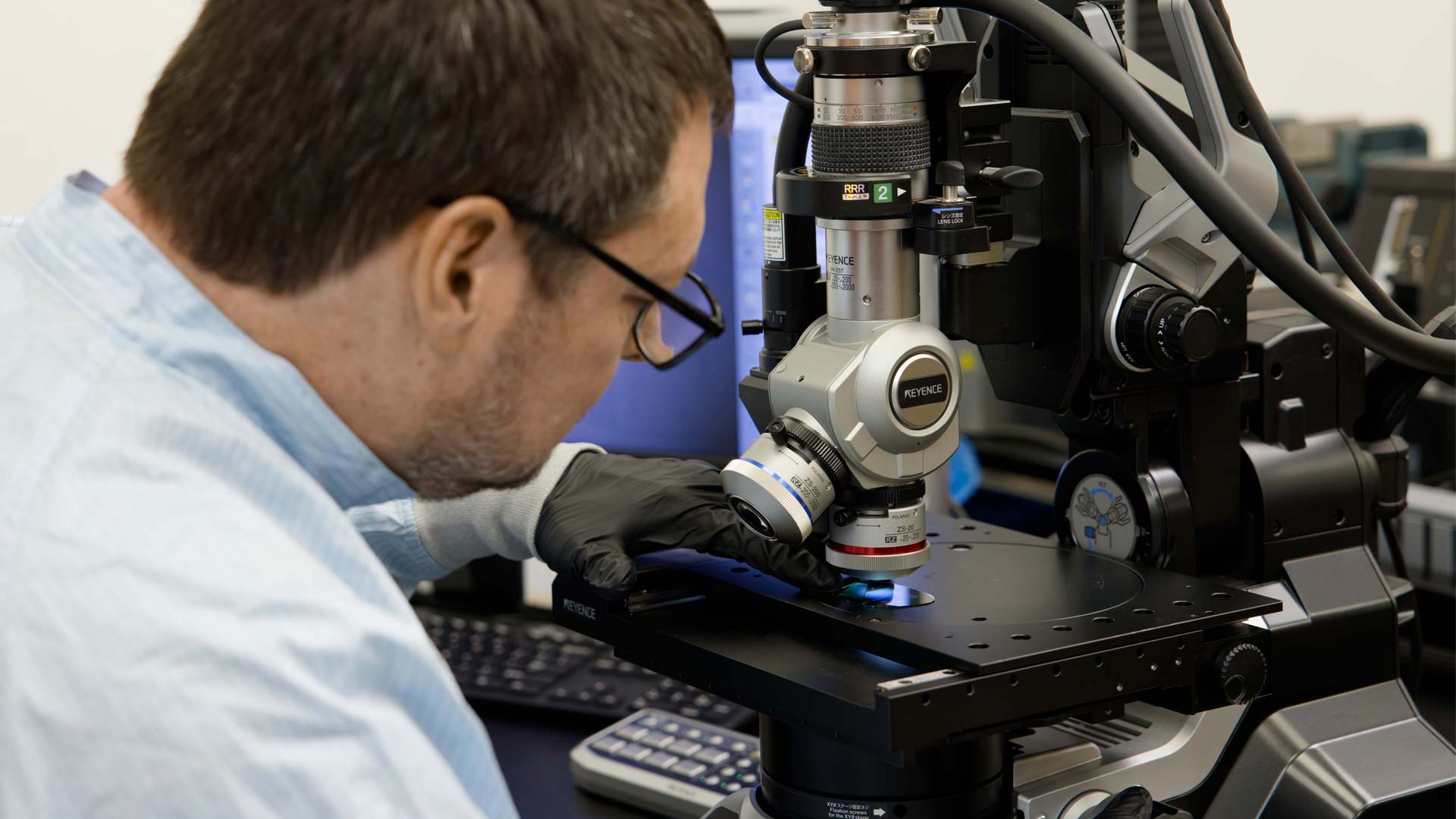
As prototypes are fabricated, metrology verifies how closely the finished gratings match their intended designs. Those measurements feed back into simulation and the next design iteration, creating a continuous cycle of modeling, fabrication, measurement, and refinement. This close collaboration helps develop the waveguide and manufacturing process together while moving promising concepts toward manufacturable solutions.
Designing for the Next Generation
As AR glasses continue evolving, surface relief grating designs will evolve alongside them. Wider fields-of-view, higher brightness, improved efficiency, and thinner form factors all depend on continued advances in both optical design and manufacturing technology.
We continue to explore increasingly sophisticated grating architectures, including advanced slanted and multi-level designs, alongside materials with higher refractive indices that can support even more efficient waveguides. Each new capability expands the range of design possibilities while introducing new engineering decisions that must be carefully balanced.
The future of waveguides won't be defined by a single breakthrough or one "perfect" grating design. As AR devices evolve, applications will continue to place different demands on field-of-view, brightness, efficiency, form factor, and other aspects of optical performance.
Meeting those requirements depends on close coordination across optical design, materials science, precision manufacturing, and metrology. Bringing those disciplines together helps us evaluate tradeoffs and develop waveguide solutions tailored to the products our partners are creating.
Explore more of our stories to learn how Magic Leap’s waveguide innovation is shaping the future of augmented reality.