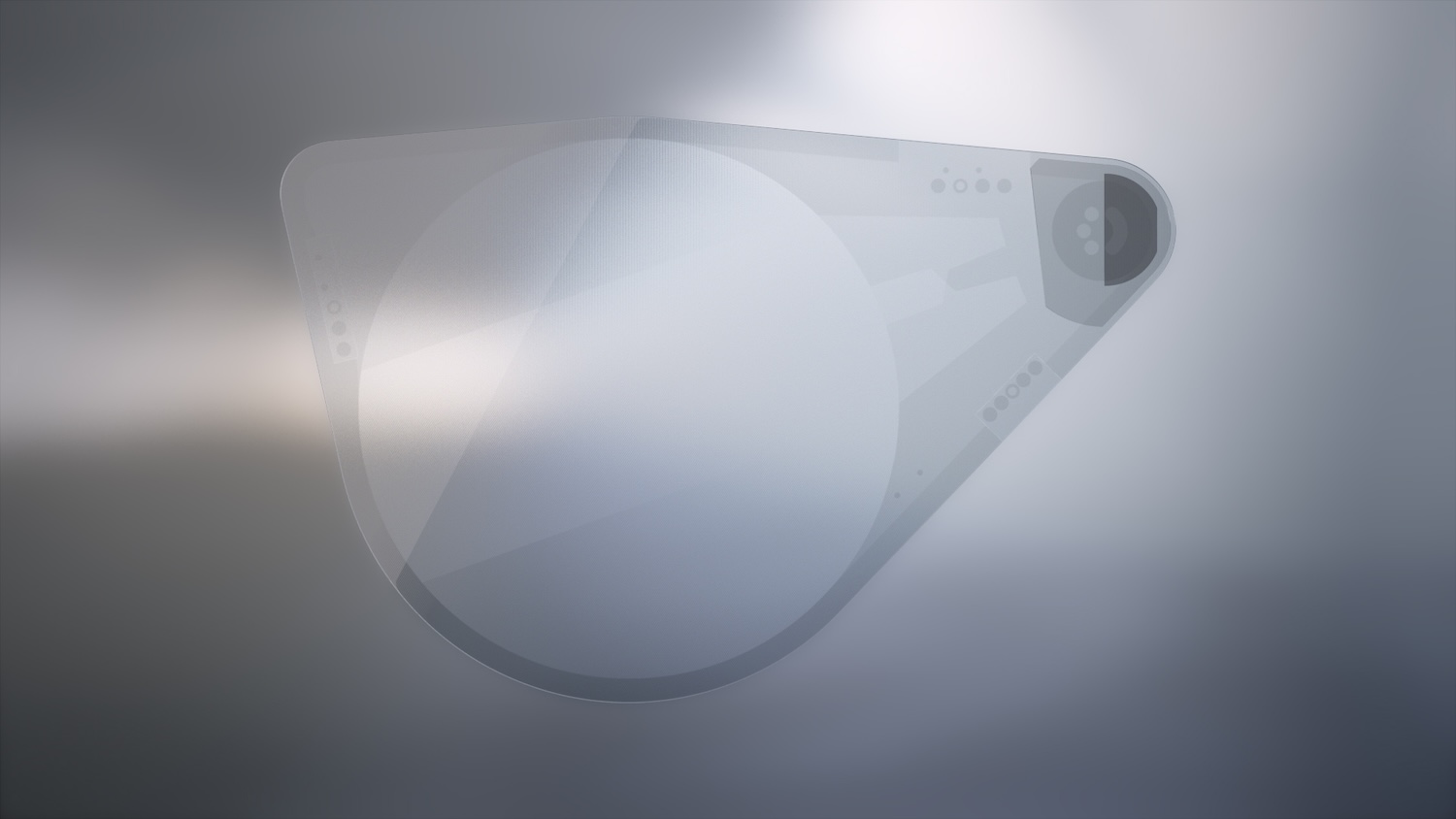
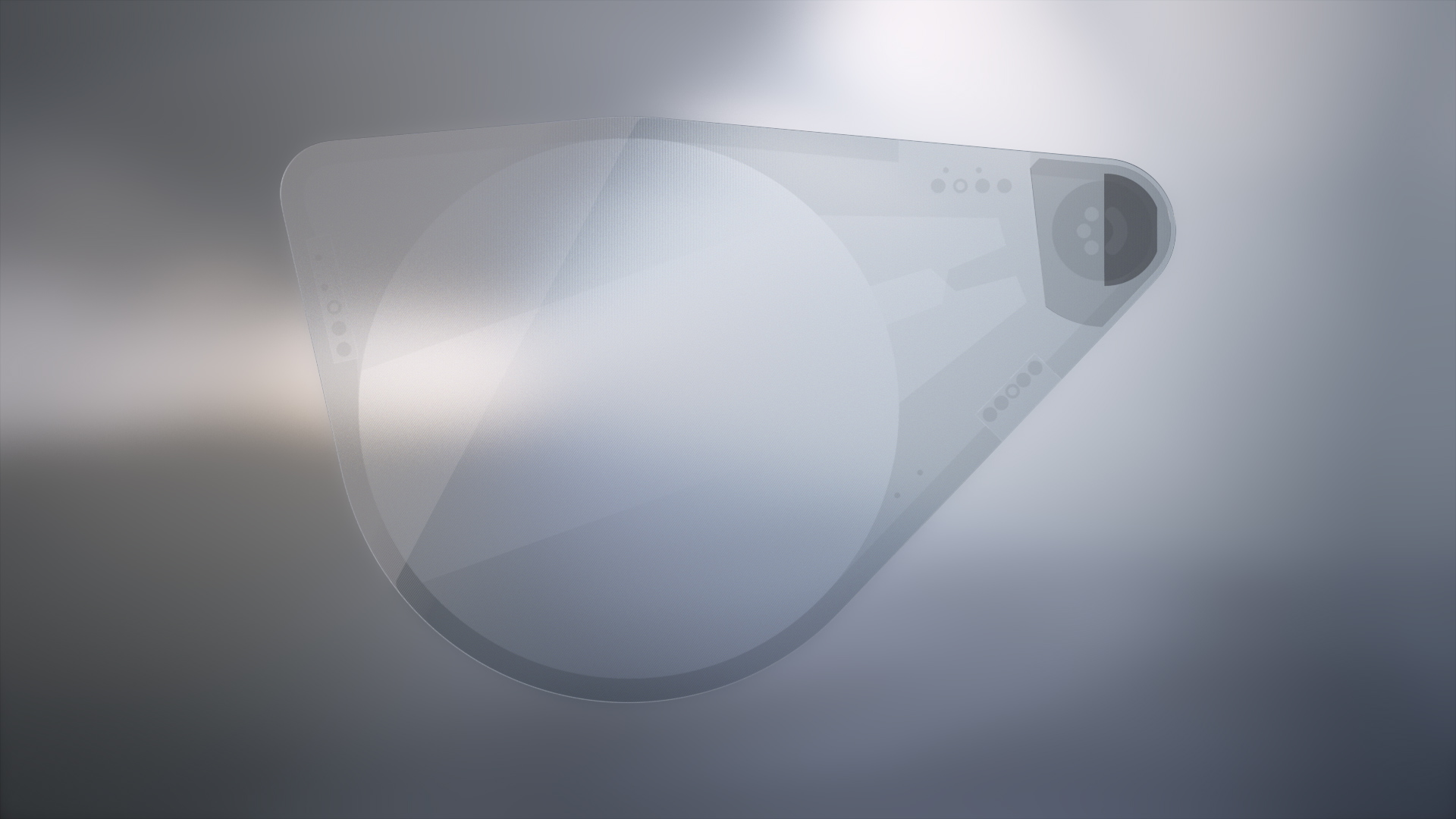
Designing for augmented reality (AR) introduces a unique set of constraints. Optical systems need to be thin, lightweight, transparent, and compatible with modern manufacturing methods.
Over the years, the industry has explored multiple approaches to meet these requirements. Each offers a different way to deliver digital imagery through a transparent waveguide or other optical assembly. However, not every approach can meet the full set of demands required for wearable AR glasses.
We evaluated these tradeoffs early and focused on advancing the design and manufacturing of diffractive waveguides to support lightweight, high-quality display systems for next-generation devices.
Exploring Optical Approaches
Diffractive waveguides use microscopic optical structures to direct light through a transparent material. Magic Leap’s waveguides are a type of diffractive waveguide that use nanometer-scale surface-relief gratings (SRGs). We chose SRGs because they combine thin, lightweight optics with manufacturing techniques that are well-suited for advanced electronics.
To understand that decision, it helps to first understand the other AR waveguide and display technologies in the market.
Volume Holographic Grating Waveguides
Surface-relief gratings are one approach to diffractive waveguides. Another approach uses volume holographic gratings (VHGs), which are created by recording optical patterns within photosensitive materials using laser beams. These recorded structures direct light through the waveguide to the user’s eye.
VHGs can enable thin waveguides with minimal eyeglow and excellent transparency. However, the holographic materials and recording processes introduce additional complexity that can make optimizing performance and maintaining manufacturing consistency across full-color displays more challenging.
Reflective Waveguides
Reflective waveguides rely on cascaded mirrors to guide light to the user’s eye. The layers of the cascade mirror are created from separate layers of glass, with different degrees of mirroring, that must be stacked together, bonded, and precisely cut.
Reflective waveguides can provide high brightness and strong optical efficiency. However, the stacked-mirror design has the potential to introduce ghosting, double reflections, and other visual artifacts. The design also necessitates waveguides with thicker optical structures and additional optical elements, such as prisms, to direct light through the system. The result is noticeably thicker and heavier devices, often resembling high-power prescription glasses.
The added forward weight in AR glasses due to the thicker optical structures, can create an imbalanced feel on the face, making extended wear less comfortable. In addition, the layered construction increases complexity and can lead to significant material waste during manufacturing.
Bird-Bath Optics
Bird-bath optics, named for their curved mirror structure, use large optical components positioned in front of the eye to project images.
Bird-bath optics can deliver bright, high-quality imagery and are often used in enterprise applications where heavier weight or a larger device form-factor are more acceptable than in consumer devices.
Like reflective waveguides, bird-bath optics introduce substantial bulk and shift the AR glasses forward on the face. The optical assembly projects outward toward the user’s eye with a distinct shape that cannot be easily integrated into thin, lightweight frames. These characteristics make it difficult to achieve the comfort and transparency expected from everyday eyewear.
Why Surface-Relief Grating Diffractive Waveguides?
VHGs, Reflective and Bird-bath optics can all produce compelling visual experiences. As AR devices move toward glasses-style form factors, the tradeoffs in thickness, weight, and manufacturing complexity become increasingly important.
This is where SRG diffractive waveguides offer a fundamentally different approach.
SRGs use precisely patterned nanometer-scale structures to direct light through the waveguide. These structures bend light into controlled paths, allowing it to propagate through the waveguide and exit toward the viewer without relying on holographic patterns, mirrored surfaces, or large optical assemblies.
This approach combines thin diffractive optics with the precision and repeatability of semiconductor-style manufacturing, making it particularly well suited for lightweight AR glasses.
Thin and Lightweight Design
Diffractive waveguides are about 500 microns thick. This is significantly smaller than many alternative optical systems, which often require thicker and heavier components, as well as additional optical elements, such as prisms. Our SRG waveguides have a slender profile with key optical elements incorporated right into the wafer-based design with no protrusions.
Their thin profile also makes them well suited for integration with prescription lenses, enabling vision correction without introducing meaningful additional bulk to the overall device.
Reducing thickness directly reduces weight. This makes it easier to design devices that can be worn comfortably for extended periods and that more closely resemble traditional eyewear.
Designed for Glasses Form Factors
Because the optical path is embedded within the waveguide itself, diffractive waveguides do not require large prisms or external structures to guide light. This allows the display system to integrate naturally into frames that look and feel like standard glasses.
The result is a more compact design that matches user expectations for wearable devices.
Flexible Optical Architecture
Diffractive waveguides allow light to enter at steeper angles, giving designers greater flexibility when positioning the projector within the device. This flexibility supports more compact system layouts and simplifies integration with different light engines and system components.
As AR devices evolve, this kind of design freedom becomes increasingly important for balancing performance, comfort, and aesthetics.
Manufacturing Aligned with Modern Electronics
Our diffractive waveguides are produced using a proprietary wafer-based fabrication process similar to those used in semiconductor manufacturing.
Our advanced techniques enable precise, repeatable fabrication of waveguides with consistent optical performance. This approach supports high-quality output and efficient production methods used throughout modern electronics manufacturing.
Unlike approaches that depend on holographic recording in specialized materials, SRGs are patterned directly into the optical substrate using photonic and semiconductor-style processes. This gives us precise control over the structures that shape light and supports highly consistent manufacturing results.
As AR devices become more mainstream, manufacturing approaches that fit with established electronics workflows become increasingly important.
Solving the Hard Problems
Diffractive optics require precise control over how light behaves within the waveguide. Factors such as color dispersion and brightness uniformity must be carefully managed to deliver a high-quality visual experience.
We have invested years in optical modeling, calibration, and iterative design to address these challenges. By understanding how light interacts with surface relief structures at a detailed level, these systems can be tuned to produce consistent color and brightness across the viewing area.
These engineering challenges can only be solved with the right expertise.
Why This Approach Matters
Early in our development work, we determined that diffractive SRG waveguides offered the best path to lightweight, comfortable AR glasses that could also be manufactured efficiently.
Our goal is to enable devices that are lightweight, comfortable, and visually compelling, while also being practical to manufacture. Diffractive waveguides offer a path forward that supports all of these priorities.
This early decision to focus on diffractive SRG waveguides has shaped years of investment in both optical design and fabrication capabilities.
Enabling the Future of AR Glasses
The next generation of AR devices will continue to move toward lighter, more natural form factors. Users expect AR glasses that look and feel like everyday eyewear, while delivering meaningful digital experiences in the physical world. Diffractive waveguides provide a foundation for meeting those expectations.
Our focus is on waveguide design and advanced manufacturing that supports bringing these systems into production. We combine optical design experience with sophisticated fabrication processes to help deliver lightweight, high-quality display solutions.
As augmented reality continues to evolve, the ability to deliver thin, efficient, and manufacturable optics will play a critical role. Diffractive waveguides represent a clear path forward.
Learn more about Magic Leap’s lightweight and wearable-friendly waveguide designs.