Augmented reality (AR) glasses are often described in terms of features, but what people actually experience is the result of a coordinated system. Optics, perception, and audio all work together to place content into the physical world in a way that feels stable and comfortable. When that coordination is done well, the technology fades into the background and the digital content feels like a seamless addition to their environment.
Achieving that level of cohesion is not simple. Each subsystem has its own constraints, tradeoffs, and design considerations, and the real challenge is bringing them into alignment. This is where our years of research, prototyping, and waveguide manufacturing expertise comes into play. We work closely with partners to shape these systems so they perform as one, rather than a collection of parts.
The Optical Foundation: Light Engine and Projectors
Everything starts with how digital imagery is created. Light engines and projectors are responsible for generating and shaping the visuals that will ultimately reach the user’s eye. The decisions made here influence brightness, efficiency, color performance, and how comfortably the system can be worn.
Our expertise in this area comes from extensive prototyping and system design, with an emphasis on balancing optical performance within the constraints of wearable devices. This includes managing power, thermal considerations, and form factor, while still delivering visuals that remain clear and consistent across different environments.
When the image is carefully controlled at the source, including brightness, color, and beam characteristics, it becomes easier to maintain quality and comfort throughout the display system.
Waveguides: Delivering Light to the Eye
Made from ultra-thin transparent materials etched with nanoscale patterns, waveguides direct light from the projector to the user’s eye while preserving a clear view of their environment.
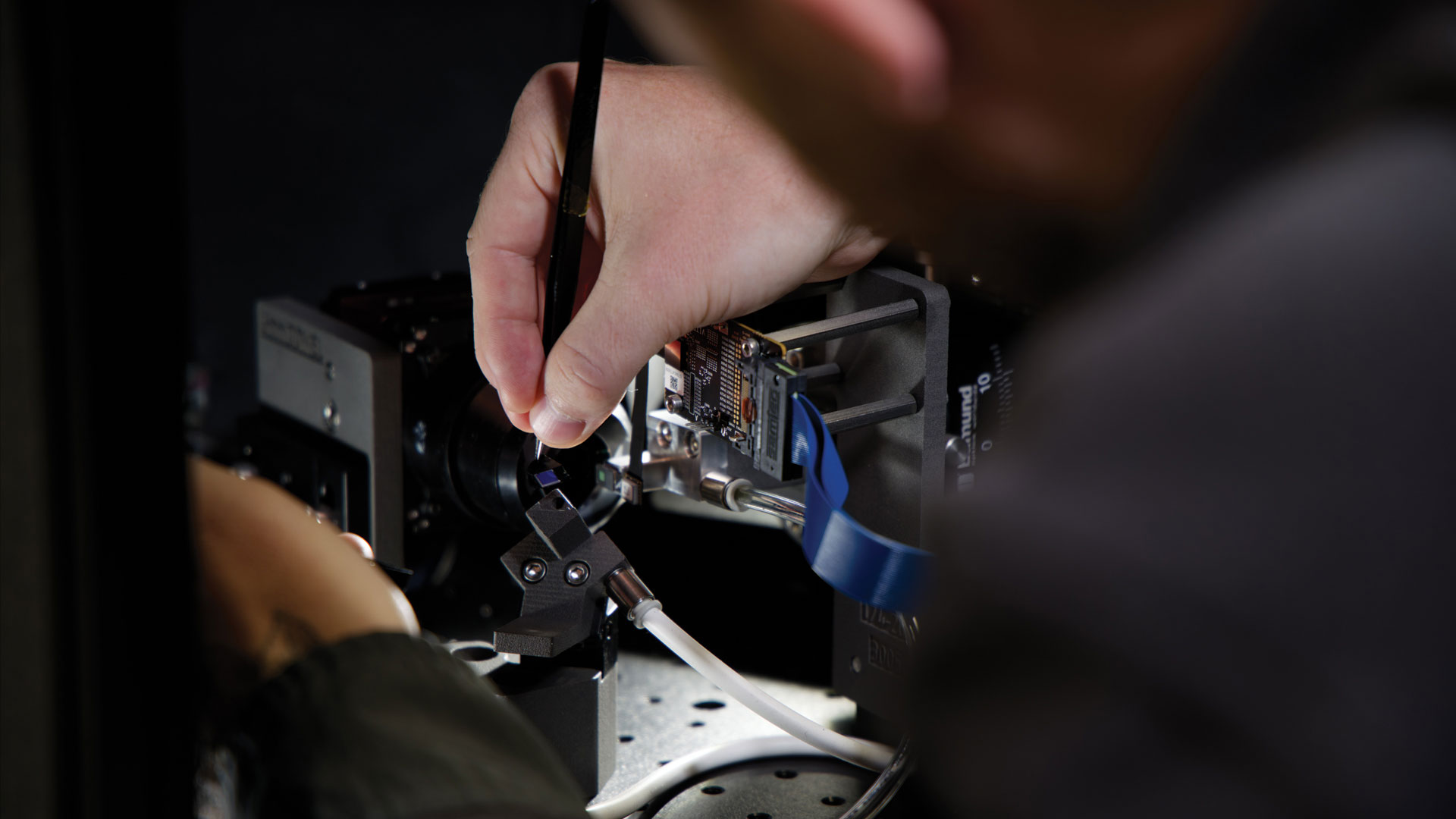
We design and manufacture waveguides using advanced techniques developed through years of focused research and investment. Precision at this stage is critical. Small variations can affect uniformity, color balance, and overall visual stability, all of which influence user comfort.
Our experience extends beyond design into production. By combining optical engineering with production-ready manufacturing approaches, we help partners move from concept to prototype and toward wearable AR glasses.
Perception System: Cameras and Sensors
For digital content to feel anchored in place, the system needs a strong understanding of its surroundings. Cameras and sensors provide that awareness, enabling spatial tracking, environmental understanding, and responsive interaction.
We have invested heavily in perception technologies, including dedicated research environments where these systems are developed and refined. This work encompasses everything from combining inputs across cameras and sensors, to calibrating each device so digital content appears in the correct place for every user. It also includes system-tuning to account for real-world conditions like changing lighting, reflective surfaces, and rapid head movement. By bringing these elements together through advanced modeling, we can improve responsiveness, helping digital content remain stable as users move through their surroundings.
There is also an important distinction to be made between simpler display approaches and more immersive systems. Monocular systems display digital content to one eye, which works well for lightweight overlays such as notifications or instructions. Binocular systems deliver coordinated images to both eyes, allowing for depth cues and a more immersive experience. With strong perception systems behind them, binocular designs can make digital content feel more naturally placed in the physical world. Our experience across these configurations allows us to guide partners toward the optimal approach for their use case, balancing complexity with performance.
Audio Integration: Contextual and Spatial Sound
Discussions of AR devices typically center on visuals, but audio plays a meaningful role in how people experience augmented reality. When sound aligns with visuals, it reinforces spatial relationships and helps direct attention in subtle, intuitive ways.
Our work in this area focuses on integrating audio as part of the broader system rather than treating it as a separate feature. Open-ear approaches allow users to stay aware of their surroundings while still receiving digital cues. For example, a navigation prompt can come from the direction of an upcoming turn, allowing the user to follow it without constantly checking a visual display.
This approach also helps reduce cognitive load. Instead of relying entirely on visual overlays, information can be distributed across senses. A subtle tone can confirm that an action has been completed, or a directional cue can draw attention without interrupting the user’s focus. Because the user does not need to interpret every signal visually, interactions feel more natural and less mentally taxing over time.
Designing audio in this context requires coordination with both optics and perception. Timing, positioning, and clarity all matter. When these elements are tuned together, audio supports a more comfortable and efficient user experience, helping digital content feel integrated rather than intrusive.
System Coordination: Bringing It All Together
The AR experience people remember is not defined by any single component. It comes from how well everything works together. Optics, perception, and audio must be synchronized and calibrated so that digital content feels stable, responsive, and integrated into the physical world.
This is where system-level expertise becomes essential. Challenges like latency, alignment, and calibration cannot be solved in isolation. They require a holistic approach that considers how each subsystem influences the others. Through years of building and refining AR prototypes, we have developed the insight needed to navigate these tradeoffs and bring systems into balance.
Our role is to work with our partners as they move from ideas to working systems. By combining waveguide design, optical engineering, and perception research, we help align the many moving parts involved in creating AR glasses prototypes. The result is a cohesive path forward, grounded in practical experience and focused on user comfort.
As augmented reality continues to evolve, the importance of integration will only grow. Systems that feel intuitive are built through coordination, iteration, and expertise brought together over time. We ensure partner designs are cohesive from the start.
Learn more about our rapid in-house AR glasses prototyping.